


Syllabus: GS3/Environment
In News
- NITI Aayog identified CCUS as critical for decarbonising hard-to-abate sectors, including steel, cement, oil and gas, petrochemicals, chemicals and fertilisers.
Carbon Capture, Utilisation and Storage (CCUS)
- It refers to a range of technologies that capture carbon dioxide (CO₂) emitted by industries such as steel, cement and power generation, preventing it from entering the atmosphere
- The captured CO₂ is either transferred into the earth or reused for industrial applications in various forms.
CCUS Process and Stages
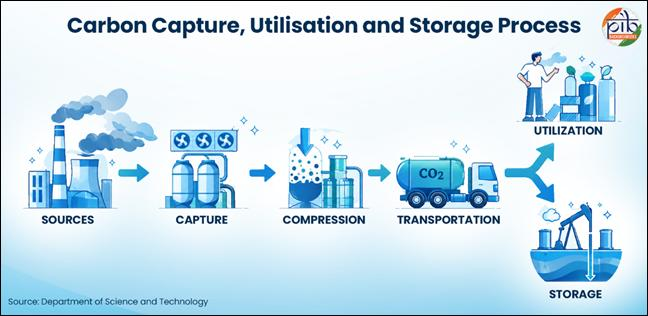
- Capture of carbon: Carbon Capture, Utilisation and Storage (CCUS) is the capture of CO 2 from industrial emissions and its cleaning, drying and compression.
- From Capture to Transport: The CO₂ captured is then delivered by pipeline, ship or other appropriate means to utilisation facilities or storage sites.
- Carbon Utilisation and Permanent Storage: It can be used in applications such as enhanced oil recovery, food and drinks, urea, green methanol and concrete, or permanently sequestered deep underground in geologic formations such as depleted oil and gas reservoirs, deep saline aquifers and basaltic rocks to help reduce greenhouse gas emissions.
Various Steps Taken
- The Government of India has undertaken initiatives spanning research, policy and industry to advance CCUS development and reduce emissions.
- These measures strengthen the foundation for India’s Net Zero target by 2070.
- Union Budget 2026–27, CCUS Scheme: Announced in February 2026, the Ministry of Finance allocated ₹20,000 crore over five years to promote carbon capture, utilisation and storage in five major industrial sectors: Power, Steel, Cement, Refineries, and Chemicals.
- Department of Science & Technology- CCUS R&D Roadmap: Launched in December 2025, the roadmap provides strategic direction for CCUS research, funding, technology development and deployment, with a focus on commercial readiness, breakthrough technologies and enabling frameworks.
- NITI Aayog CCUS Policy Framework & Mechanism: Released in November 2022, the report examines CCUS as an emissions reduction strategy for deep decarbonisation of hard-to-abate sectors and outlines sector-specific policy interventions for its deployment.
- National CCUS Centres: Established in 2022 at IIT Bombay and JNCASR, Bengaluru, with backing from the Department of Science and Technology, these centres focus on CCUS research, technology development, pilot-scale demonstration and industry collaboration.
- India’s CCUS Initiative: Spearheaded jointly by the Department of Science and Technology (DST) and the Department of Biotechnology (DBT), India launched a major research drive on CCUS.
- As part of Mission Innovation, a global clean energy platform, India collaborated with 13 partner countries to advance technologies to capture, separate, safely store, and convert CO2 into useful value-added materials.
- India launched its first cluster of five Carbon Capture and Utilisation testbeds for the cement industry on 11th May 2025.
- Led by the Department of Science and Technology (DST), the initiative brings leading cement companies and premier research institutions together under a Public-Private Partnership model to develop and deploy industrial CCU technologies.
Source: PIB
Previous article
Richard J. Roberts Backed GM Crops for India and Developing World
Next article
Grey-Zone Warfare and the LAC
